

What Edge of Tomorrow gets right about AI
I am a self-described amateur cinephile, which is probably a slightly pretentious way of saying I really like movies. But increasingly, it is not just the movies themselves that fascinate me. It is the art of making them: the choices underneath the dialogue, editing, cinematography, music, and character development. Occasionally, somebody points one out, and I cannot stop thinking about it.
That happened while watching Paul Tweddle’s Edge of Tomorrow breakdown on Heavy Spoilers. It sent my mind somewhere the filmmakers may never have intended: artificial intelligence. This Ridgeline Review follows that connection and why the ability to rehearse a decision does not remove our responsibility for making it. [1]
Spoilers ahead for Edge of Tomorrow…. but the movie is 12 years old, so you have had plenty of warning. If you have not seen it, though, I highly recommend watching it first.
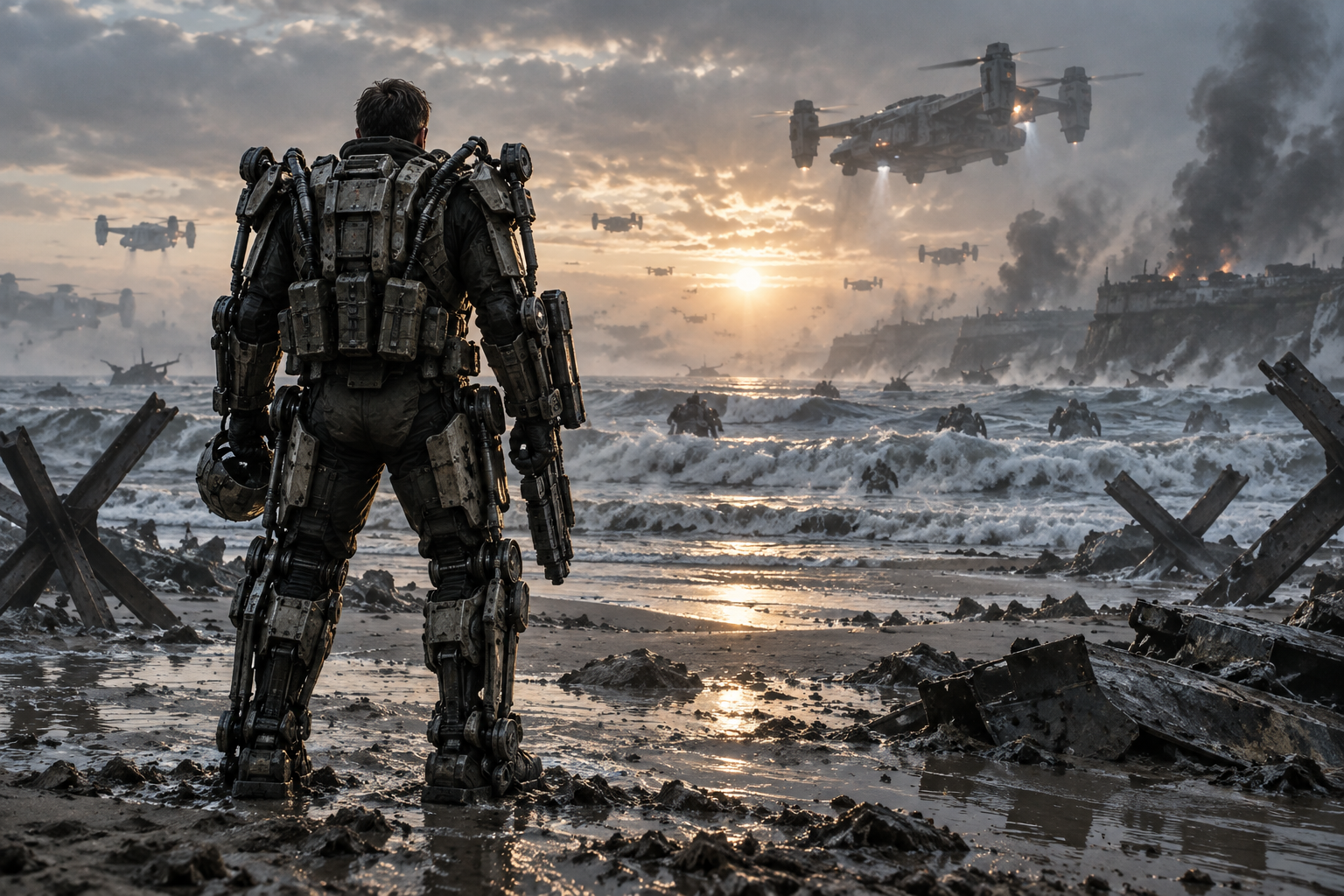
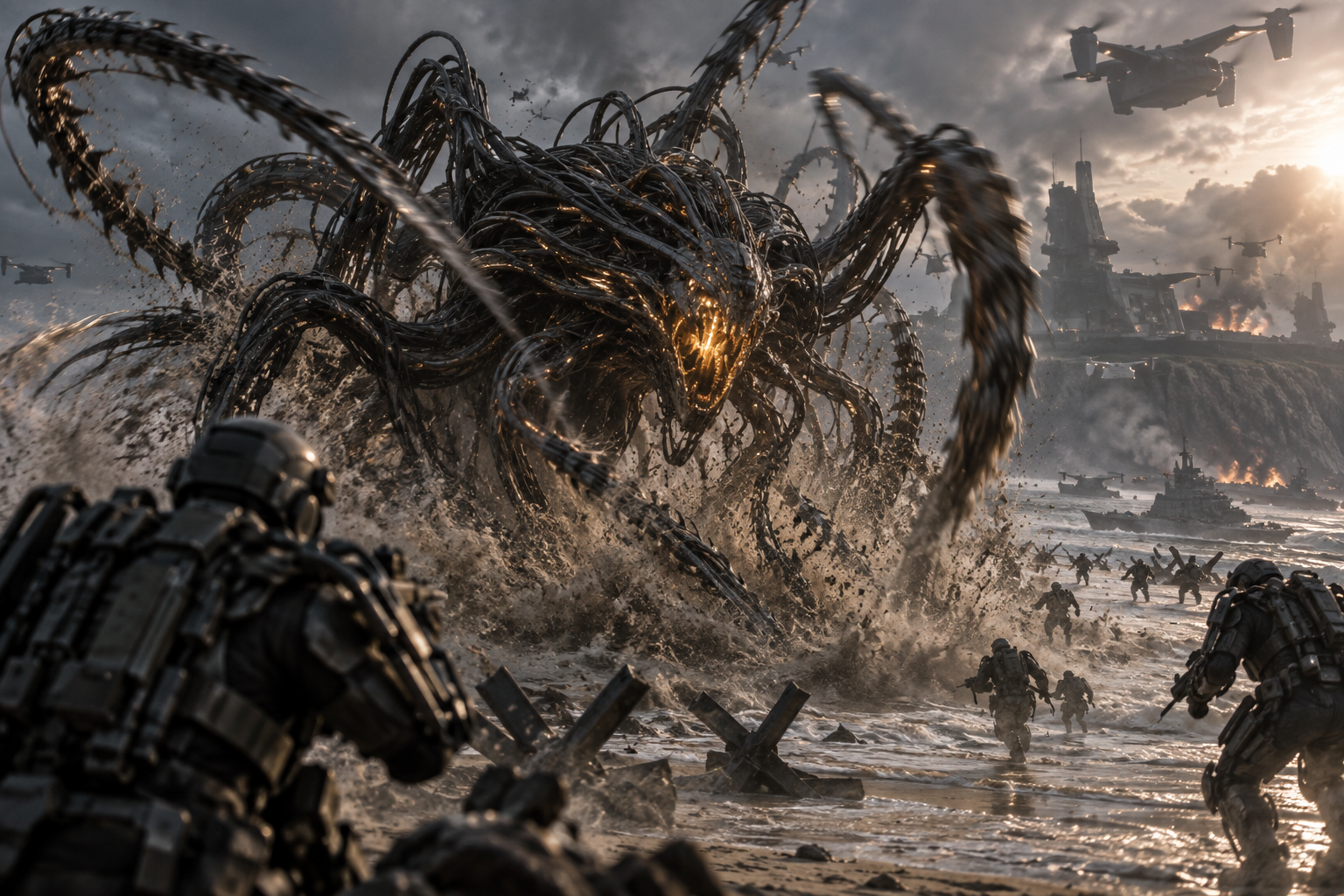
If you have not seen Edge of Tomorrow, the premise is brilliantly simple. In a battle, Tom Cruise’s character, Cage, dies and then wakes up at the beginning of the day. It is essentially a sci-fi action version of Groundhog Day. The longer explanation involves humanity fighting an alien species called the Mimics. Their greatest advantage is their relationship with time. The Mimics operate as an interconnected organism: the Omega sits at its center, and killing one of the rarer Alphas triggers a reset. The enemy can use knowledge of a failed encounter to change the next attempt. When Major William Cage acquires that ability, the battlefield becomes something he can rehearse. [2]
Attack here. Fail. Reset. Change the sequence. Try again.
From the outside, it looks like learning, and that is a useful starting point for the analogy. A system receives feedback from an attempt and changes what it does next. But the film does not establish that the Mimics merely guess or lack intelligence. Their manipulation of Cage suggests an adversary capable of deception. I read them as a metaphor for AI, not a scientific explanation of the aliens.
The connection to games is less speculative. The film was adapted from Hiroshi Sakurazaka’s All You Need Is Kill. In a 2014 interview, Sakurazaka discussed repeated failure, renewed attempts, and eventual success in games as experiences from his own life that could form a continuous story. The repetition is part of the source material’s creative foundation. [3]
In AI research, the closest comparison is reinforcement learning. An agent interacts with an environment and uses rewards to improve its policy, meaning the way it selects actions. In a landmark 2015 study, Volodymyr Mnih and colleagues trained a deep Q-network on Atari games using screen pixels and game scores. It learned effective play across a collection of games without a separate hand-designed strategy for each one. [4]
That is more sophisticated than trying every possible answer. Learning depends on how the system represents the situation, explores alternatives, and uses feedback. Repetition alone does not guarantee a good result. And this analogy should not be stretched to cover every AI system: generating another chatbot response is not necessarily a new training episode that changes the model. Cage’s early progress nevertheless feels familiar. He learns where to move, when to duck, and what comes next. His apparent instinct increasingly reflects encounters that nobody else remembers. He is effectively rehearsing reality.

I have become a strong believer in using AI because it can make difficult work more manageable. It can help organize material, generate alternatives, and challenge an assumption. Used carefully, that gives me more room to think about the problem instead of spending all my time mechanically processing it.
Evidence supports that benefit, with an equally useful qualification. Fabrizio Dell’Acqua and colleagues studied 758 knowledge workers completing realistic professional tasks. AI assistance improved performance on tasks within the system’s capabilities, but reduced correctness on a task selected to fall outside them. The lesson is task-specific: success on one kind of work does not establish reliability on the next. [5]
That is why I like the idea of AI as a rehearsal partner. Before a difficult discussion, it can help explore objections. Before an exercise, it can help generate scenarios. During an investigation, it can suggest questions worth testing. Those suggestions still need to be checked against original sources and the actual circumstances.
A plausible scenario is not a prediction. A persuasive explanation is not evidence. If the rehearsal contains a bad assumption, repeating it can make us more comfortable with the mistake.
What interests me most about Cage and Rita is how their relationship changes during those repetitions. Cage begins to care about Rita. For Rita, who does not retain Cage’s memories between resets, they have to build trust within the day they are living. That imbalance creates much of their relationship’s tension.
The decisions become more than a sequence of movements through a battlefield. Cage’s attachment influences what he reveals and which risks he is willing to take. Feeling responsible for someone can motivate courage, but it can also complicate judgment. The film is more interesting because humanity is messy.
Then Cage loses the ability to reset after receiving a blood transfusion. Going into the final mission, he and the team have to act without expecting another attempt. The ending gives him an unexpected further reset after the Omega is destroyed, but that is not a safety net the team can rely on when making its decision.
They must use what they have learned while accepting that the next encounter may not follow the rehearsed sequence. For me, that is the film’s strongest connection to real work. Preparation matters precisely because we cannot expect reality to repeat itself on demand.
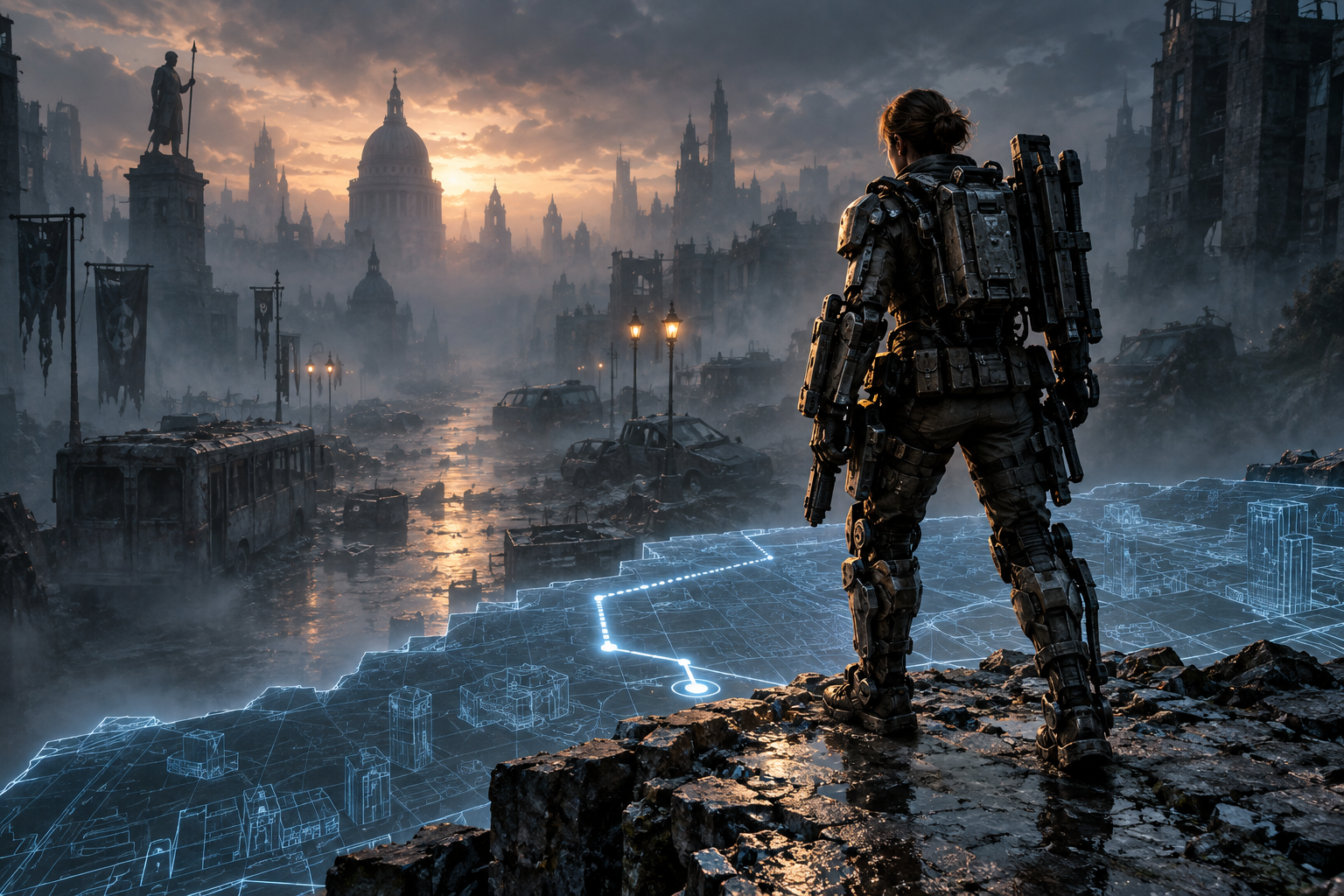
It would be convenient to make this a story about cold machines and infallible human instinct. Psychology gives us a more demanding answer.
Daniel Kahneman and Gary Klein argued that dependable intuition requires an environment with learnable regularities and sufficient opportunity to learn them. Confidence alone does not establish expertise. A person can feel certain because they recognize a meaningful pattern, or because a misleading situation resembles something familiar. [6]
Cage has an extraordinary learning environment: repeated exposure to closely related events and immediate feedback. Most investigators and security teams do not. Their information is incomplete, feedback may arrive late, and an adversary can change behavior.
That makes instinct valuable as a reason to look more closely, not as a substitute for verification. If something feels wrong, I want to identify the observation behind that feeling, test another explanation, and find out what would change my mind. The same discipline should apply when an AI system offers a confident answer.
I would also avoid resting the argument on sweeping claims about whether a machine could ever have experience or understanding. Those are larger scientific and philosophical questions than a film review can settle. The practical issue is clearer: people and organizations must own the decisions made with these tools. An AI output cannot take that responsibility away from us.
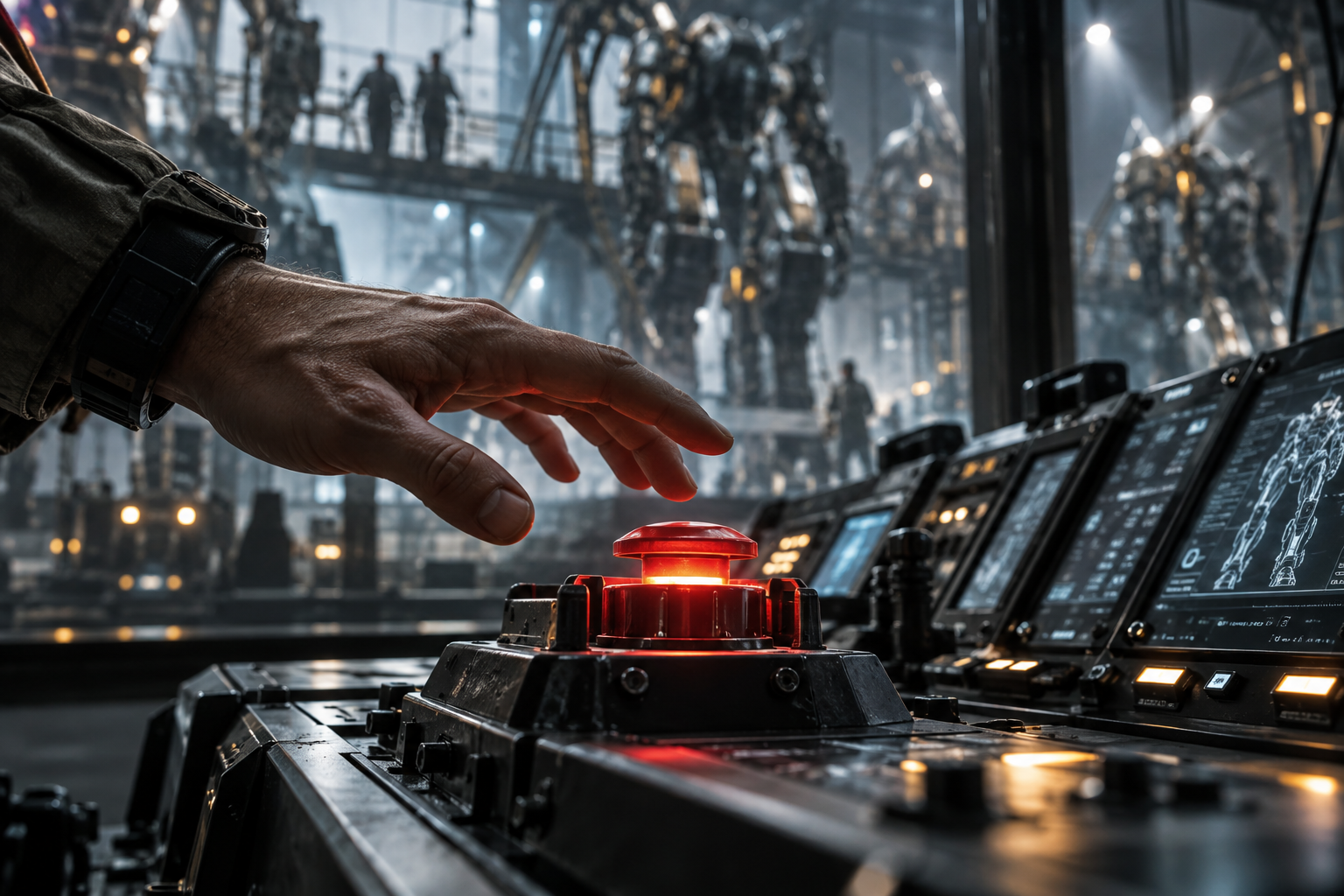
A phrase is used constantly in conversations about AI: human in the loop. I think we sometimes misunderstand what that should mean. A human who simply clicks approve adds a step but may not add meaningful scrutiny.
In an experiment involving 199 participants, Zana Buçinca and colleagues found that interventions designed to prompt more deliberate thinking reduced overreliance on AI compared with simpler explanatory interfaces. The most effective interventions were also less popular with participants. Helpful friction can feel inconvenient. [7]
Combining people and AI does not automatically produce the strongest team. Michelle Vaccaro and colleagues’ meta-analysis found that human–AI combinations, on average, performed worse than the better of the human or AI alone. Results differed across tasks, with more favorable outcomes for content creation than for decision tasks. Collaboration must be designed and evaluated; its benefits cannot be assumed. [8]
For the kinds of work Cipher Ridge focuses on, I would translate that into a few habits: form an initial assessment before asking the tool to supply one; trace important claims to source material; examine competing explanations; and record why a consequential recommendation was accepted or rejected. These are practical applications of the research, rather than a claim that any one study validated an entire investigative workflow.
NIST’s AI Risk Management Framework reinforces the organizational side of that responsibility. It calls for defined human roles and oversight, and recognizes that representing complex human situations mathematically can remove necessary context. Oversight needs to fit the use case and its consequences. [9]
Context, empathy, and professional judgment matter here. So do time, authority, and access to the evidence. If the person reviewing an answer cannot challenge it, the word oversight is doing too much work.
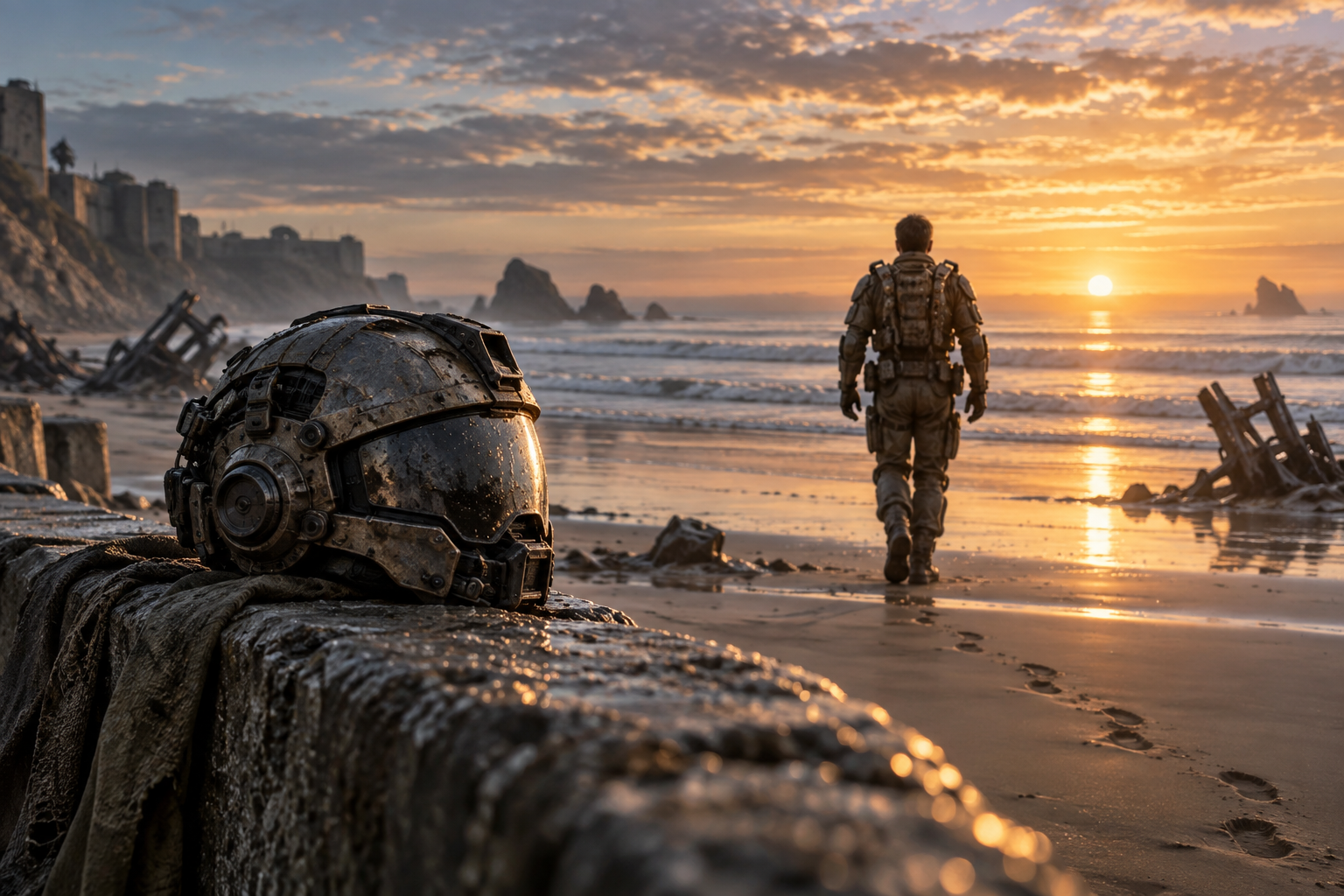
Which brings me back to Edge of Tomorrow. Repetition gives Cage knowledge he could never otherwise acquire. The final mission still depends on people who must decide what to do with that knowledge, with incomplete information and no expected second chance.
That is the partnership I want from AI. Help me explore the possibilities. Help me notice something I missed. Help me prepare. Then make sure there is a real process for checking the answer and a person willing to own the decision.
The machine’s usefulness does not depend on pretending it is human. Our responsibility doesn’t disappear just because it is useful.
Eventually, the script runs out. That is when preparation has to become judgment.
This Ridgeline Review was inspired by Paul Tweddle’s Heavy Spoilers analysis of Edge of Tomorrow. His breakdown prompted me to connect the film to learning and human responsibility. The AI interpretation here is mine.
Watch the Heavy Spoilers breakdown
Notes:
[1] Paul Tweddle, “EDGE OF TOMORROW (2014) Breakdown | Film Analysis, Book Differences, Ending Explained & Review,” Heavy Spoilers, August 21, 2026, video, https://www.youtube.com/watch?v=-zjdL4hkIzw. Episode metadata: https://podcasts.apple.com/ie/podcast/edge-of-tomorrow-2014-breakdown-film-analysis-book/id1815685037?i=1000786570966.
[2] Edge of Tomorrow, directed by Doug Liman (Warner Bros. Pictures, 2014), film. Plot discussion throughout this review refers to the film; interpretations of its themes are the author’s.
[3] Chiaki Hirano, “Japanese Light Novel Adapted into a Tom Cruise Film: Interview with Author Hiroshi Sakurazaka” [title translated from Japanese], Weekly ASCII, July 12, 2014, https://weekly.ascii.jp/elem/000/002/624/2624237/. Paraphrased from Japanese.
[4] Volodymyr Mnih et al., “Human-Level Control through Deep Reinforcement Learning,” Nature 518, no. 7540 (2015): 529–33, https://doi.org/10.1038/nature14236.
[5] Fabrizio Dell’Acqua et al., “Navigating the Jagged Technological Frontier: Field Experimental Evidence of the Effects of Artificial Intelligence on Knowledge Worker Productivity and Quality,” Organization Science 37, no. 2 (2026): 403–23, https://doi.org/10.1287/orsc.2025.21838.
[6] Daniel Kahneman and Gary Klein, “Conditions for Intuitive Expertise: A Failure to Disagree,” American Psychologist 64, no. 6 (2009): 515–26, https://doi.org/10.1037/a0016755.
[7] Zana Buçinca, Maja Barbara Malaya, and Krzysztof Z. Gajos, “To Trust or to Think: Cognitive Forcing Functions Can Reduce Overreliance on AI in AI-Assisted Decision-Making,” Proceedings of the ACM on Human-Computer Interaction 5, no. CSCW1 (2021), article 188, https://doi.org/10.1145/3449287.
[8] Michelle Vaccaro, Abdullah Almaatouq, and Thomas Malone, “When Combinations of Humans and AI Are Useful: A Systematic Review and Meta-Analysis,” Nature Human Behaviour 8 (2024): 2293–2303, https://doi.org/10.1038/s41562-024-02024-1.
[9] Elham Tabassi, Artificial Intelligence Risk Management Framework (AI RMF 1.0), NIST AI 100-1 (Gaithersburg, MD: National Institute of Standards and Technology, 2023), GOVERN 3.2 and appendix C, https://doi.org/10.6028/NIST.AI.100-1.