

VPNs have become shorthand for “being secure online.” Turn one on, the little shield turns green, your IP address changes, and it feels like everything you do is suddenly wrapped in a protective bubble. That is not quite how it works.
A VPN is an extremely useful tool, but it solves a specific problem: it protects a network connection. It does not automatically protect the person, the device, or everything happening on the other side of that connection.
Understanding that difference makes VPNs much more useful.
What a VPN was actually built to do
VPN stands for Virtual Private Network, and the name tells you a lot about its original purpose.
Before consumer VPN subscriptions became associated with privacy, streaming, and anonymous browsing, VPN technology was primarily used to extend private networks across non-private infrastructure.
Instead of paying for a dedicated communications line between two offices, an organization could use the public internet as the transportation layer and create a protected connection across it. Remote workers could do the same thing, securely connecting a laptop back to an organization's internal network.
NIST describes a VPN as a virtual network built on top of existing networks that can provide secure communications between systems. In other words, the internet underneath never became private. The VPN created a private path across it.
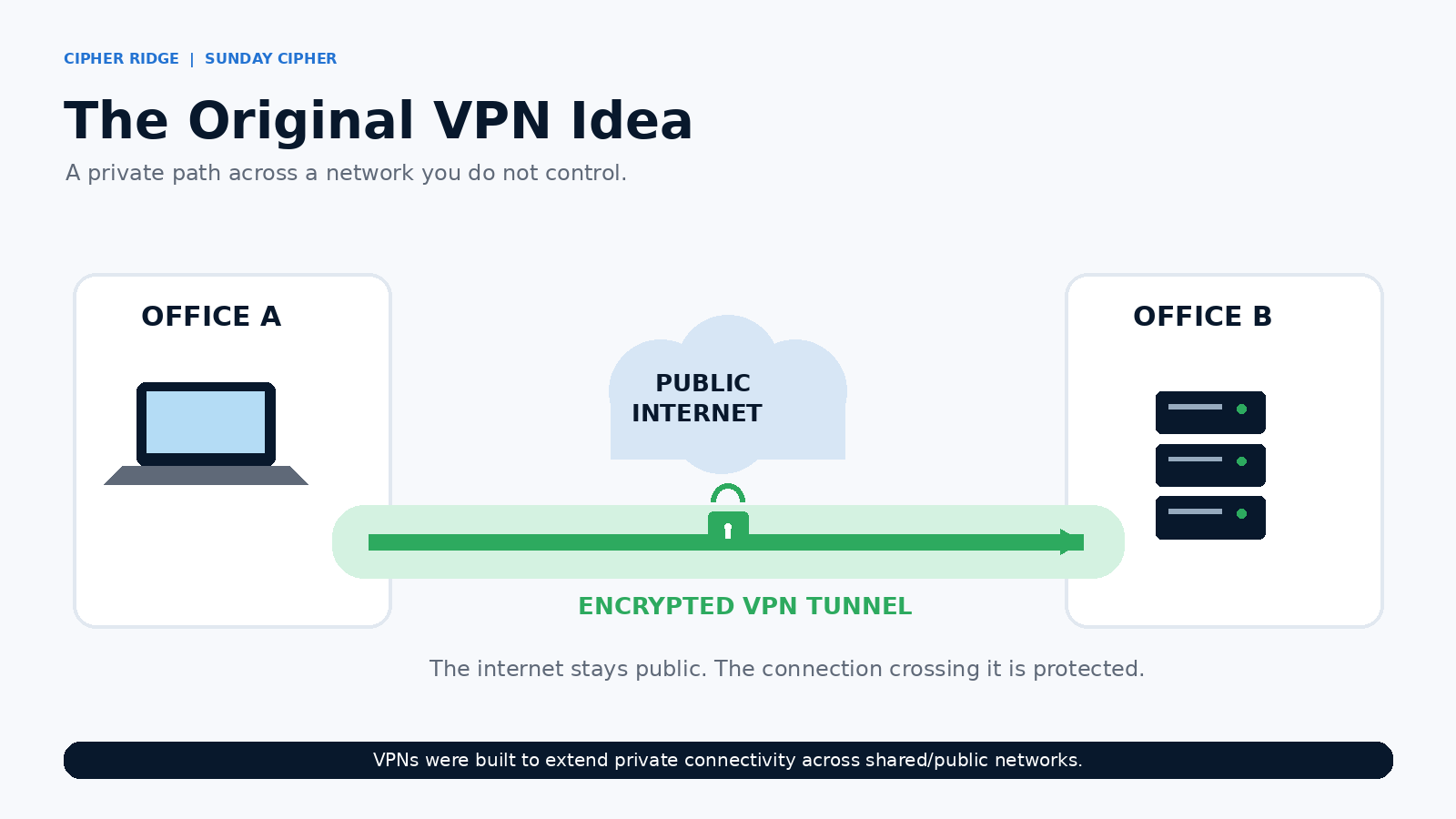
Consumer VPNs use essentially the same concept. The difference is where the tunnel goes.
Instead of:
Your laptop → VPN tunnel → company network
you get:
Your laptop → VPN tunnel → VPN provider → internet
And that last arrow matters.
The tunnel has an exit
Imagine you are in London and connect to a VPN server in New York.
Your traffic travels through an encrypted tunnel from your device to that VPN server. Your hotel Wi-Fi, coffee shop network, or internet provider can generally see that you are communicating with a VPN service, but the traffic traveling inside that tunnel is protected from them.
Then your traffic reaches New York.
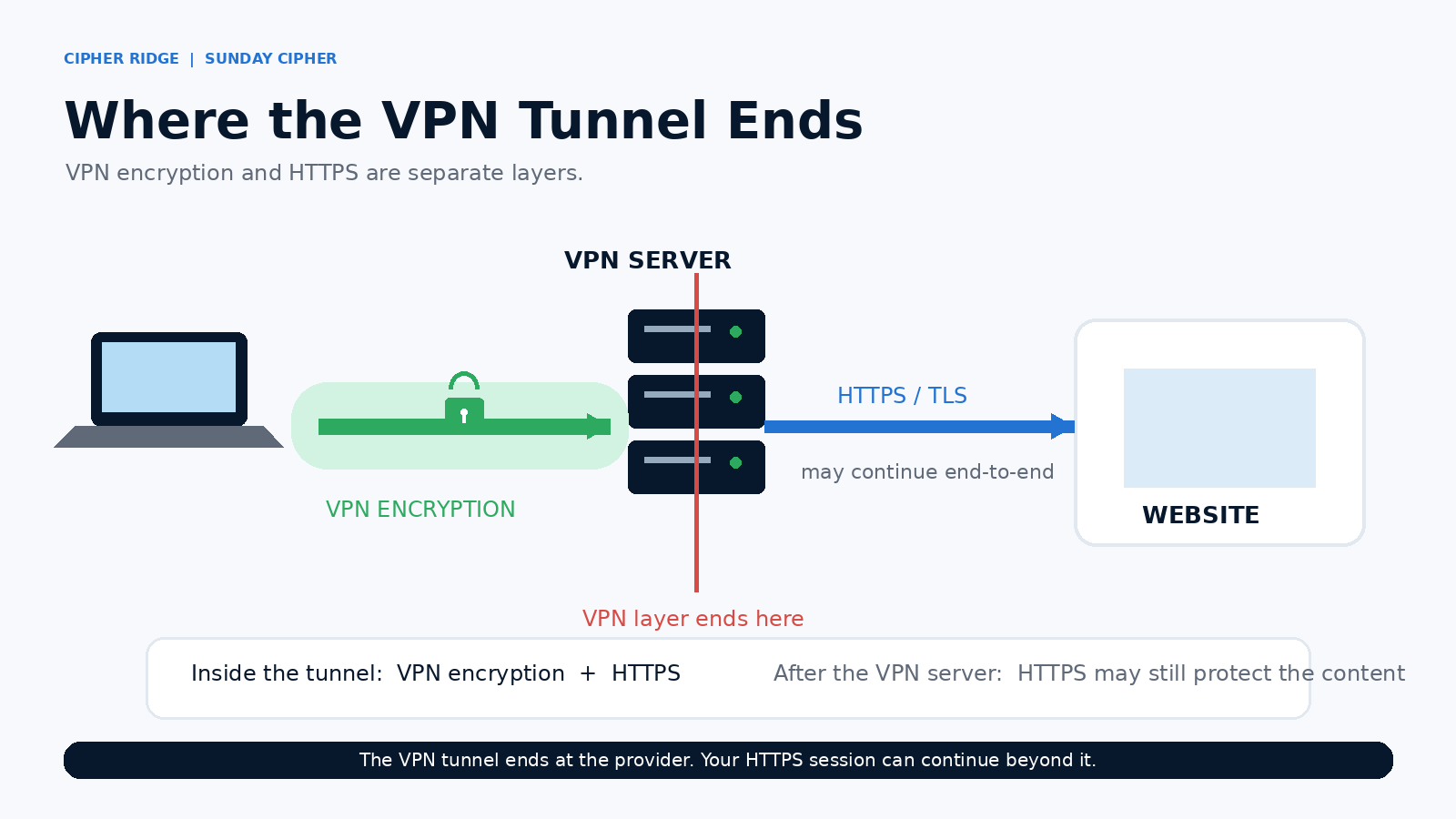
The VPN server is the termination point.
The VPN encryption layer ends there, and the server sends your traffic toward whatever website, app, or service you were trying to reach.
That does not mean your passwords and banking information suddenly spill onto the open internet.
Modern web traffic normally has another layer of encryption: HTTPS/TLS.
Think of it as one locked box inside another.
Inside the VPN tunnel, you may have:
VPN encryption → HTTPS encryption → your data
At the VPN server, the outer VPN layer comes off:
HTTPS encryption → your data
The HTTPS connection can continue all the way between your browser and the website.
That distinction is important. The VPN protects the connection to the VPN server. HTTPS may continue protecting the actual content after the VPN tunnel ends.
A VPN can do a lot. It just can't do everything.
A good VPN can hide your normal public IP address from websites. It can reduce what your ISP or local network can see. It can protect traffic crossing networks you do not trust. It can securely connect you to a private company or home network. It can also add confidentiality, integrity, and authentication to network traffic crossing public infrastructure.
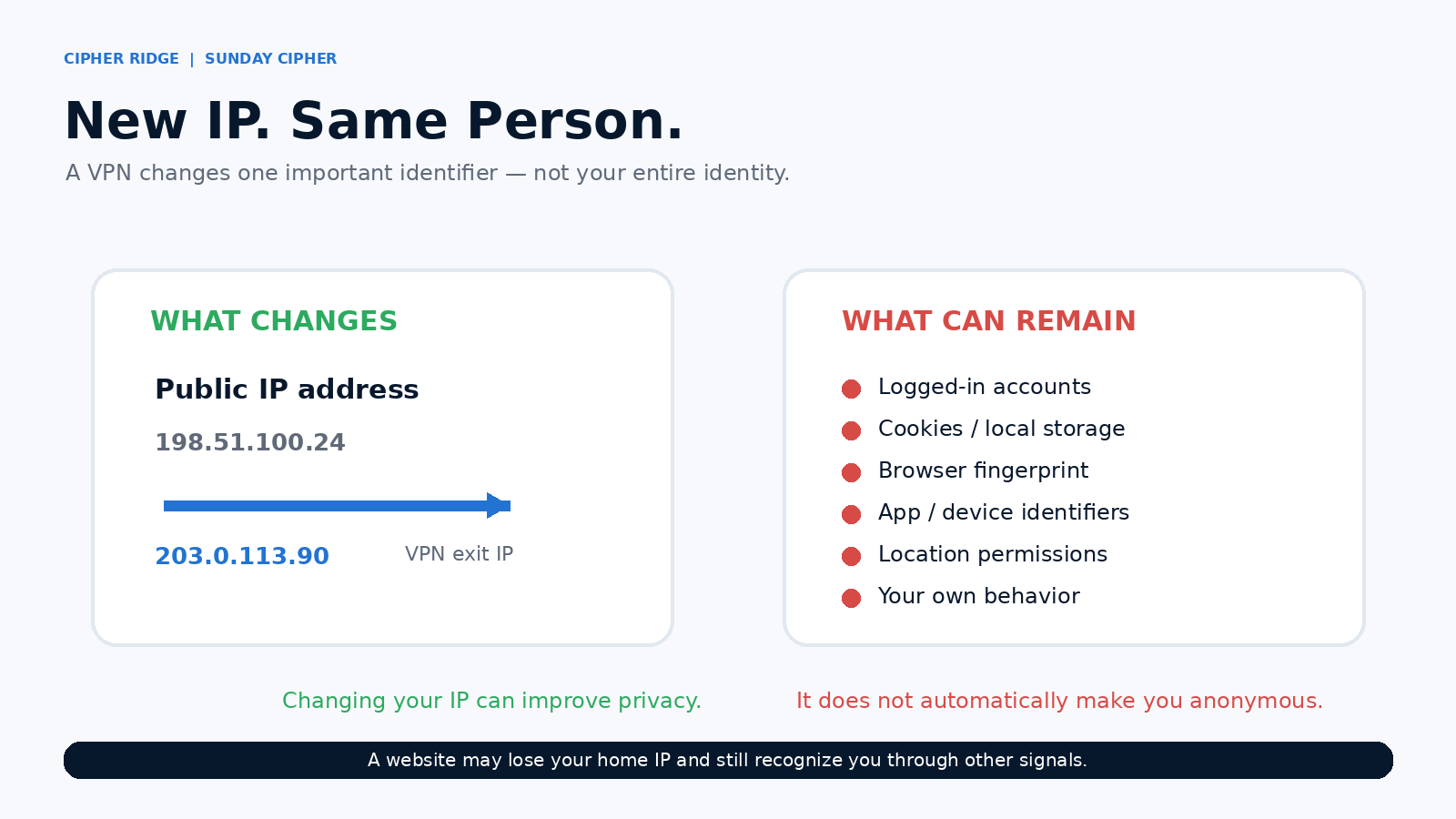
Those are meaningful security advantages. But this is where the marketing often gets ahead of the technology. A VPN does not automatically make you anonymous.
Change your IP address and then log into Google, Facebook, Amazon, or your bank, and those services still know exactly which account is being used. Cookies can remain. Browser fingerprints can remain. Apps may have their own identifiers. Location permissions may still reveal where a device is.
Changing your IP address is not the same thing as changing your identity.
The same applies to security threats. A VPN does not inherently stop phishing, malware, weak passwords, malicious downloads, social engineering, compromised accounts, or an already-infected computer.
A secure tunnel leading to a phishing page still leads to a phishing page. And a secure tunnel connected to a compromised device is still connected to a compromised device. That is why I think one of the worst ways to describe a VPN is as something that “protects you from hackers.”
It protects certain communications from certain threats. That is much more precise.
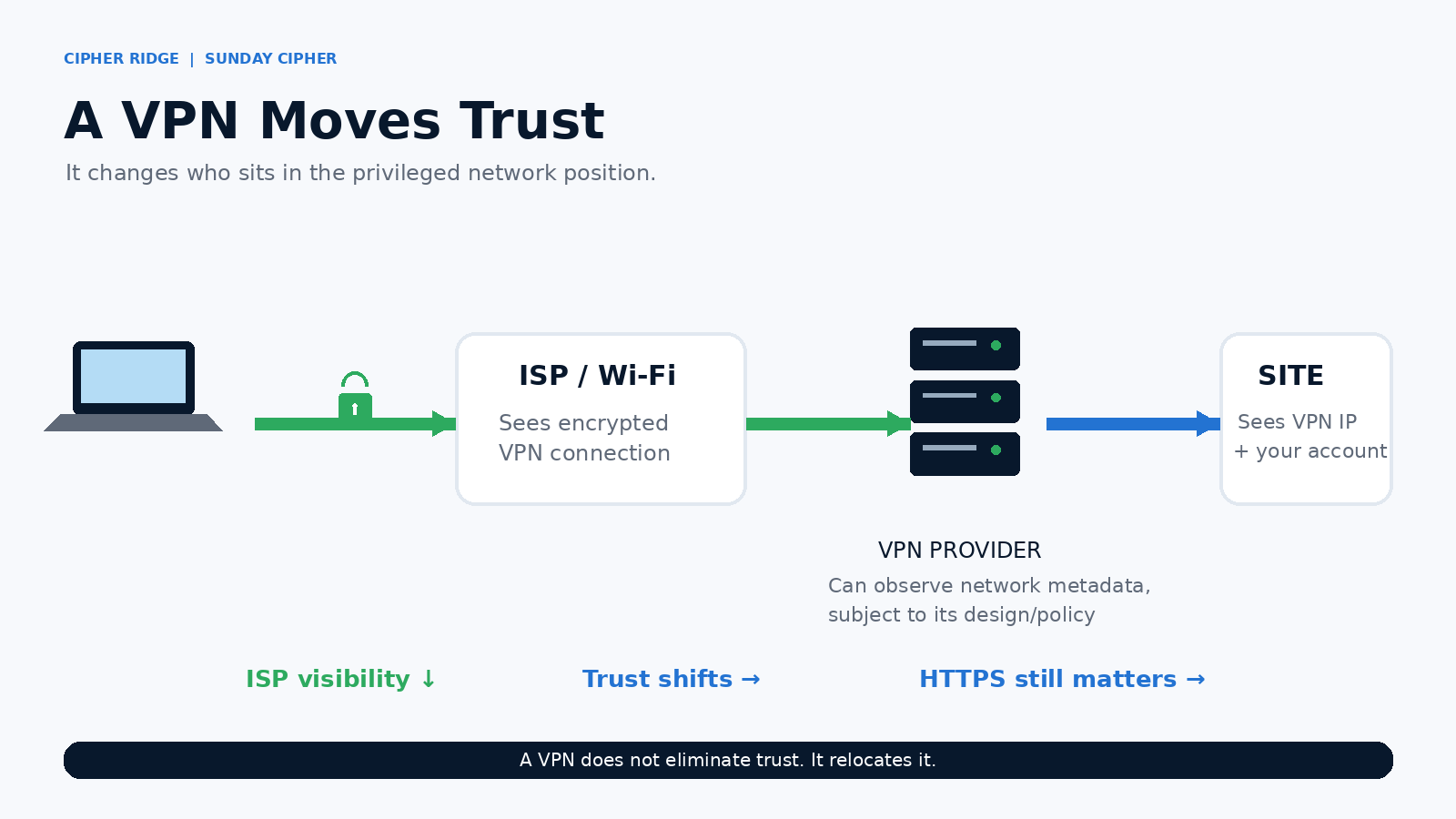
A VPN does not eliminate trust. It moves it.
This may be the most important privacy lesson. Without a VPN, your internet provider occupies a powerful position between you and the internet.
With a commercial VPN, your ISP sees an encrypted connection to the VPN service. The VPN provider now operates the infrastructure where that encrypted tunnel ends.
You have not removed trust from the equation. You changed who you are trusting.
That is why choosing a VPN should involve more than comparing speeds or counting servers.
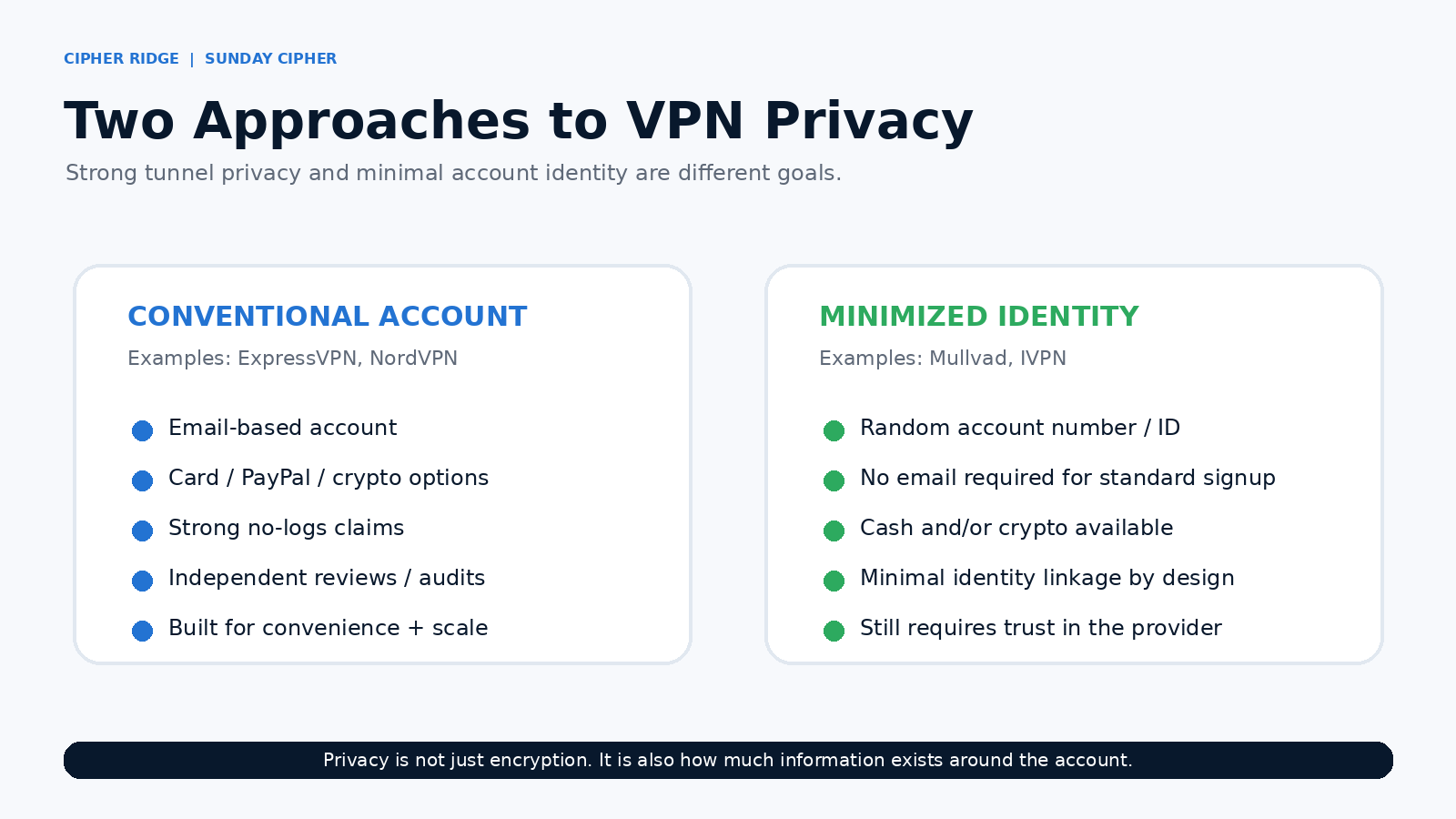
Mainstream services such as ExpressVPN and NordVPN emphasize convenience, large infrastructure, easy-to-use apps, and privacy protections. For most people, that model provides a practical balance between usability and privacy.
Other providers take a more aggressive approach to minimizing identity.
Mullvad, for example, uses numbered accounts rather than the usual username-and-email registration model, and has long supported privacy-conscious payment options.
Services such as IVPN follow a similar philosophy of collecting as little identifying information as practical.
That creates an important distinction:
Traffic privacy and account privacy are not the same thing.
A VPN might do an excellent job protecting traffic while still knowing who owns the subscription. Another provider may deliberately design its signup process so it knows very little about the customer in the first place.
Neither model changes the fundamental function of the VPN tunnel. They change how much trust and identity exist around it.
Crypto payments fit into this discussion too, but they deserve some skepticism.
Paying with cryptocurrency does not magically make a transaction anonymous. Depending on the currency and how it was obtained or transferred, blockchain activity can sometimes be correlated with a person.
The privacy advantage is more straightforward: crypto can allow a customer to pay without handing a VPN provider the same traditional billing information associated with a credit card. Combine that with a service that does not require your name or email address, and considerably less personal information may exist in the provider's records.
That is privacy by data minimization, not magic.
What about public Wi-Fi?
This is another area where old security advice refuses to die. Years ago, a much larger percentage of web traffic traveled over unencrypted HTTP. Someone positioned on the same network had far more opportunity to observe sensitive traffic. Today, HTTPS protects most normal web sessions before a VPN ever enters the picture.
A VPN can still be valuable on hotel, airport, café, or other networks you do not control. It adds another protective layer and limits what the local network can observe. But the old warning that “anyone in Starbucks can read everything you do unless you have a VPN” does not accurately describe the modern web.
Security changes. Our advice needs to change with it.
The real question is who can see what
Think about the connection in layers.
Your ISP may see that you are connected to a VPN.
Your VPN provider handles traffic as it leaves the tunnel.
The website sees the VPN server's IP address rather than your normal one.
The website may still recognize your account, cookies, browser, device, and behavior.
HTTPS may protect the content between you and the website.
Advertisers and tracking systems may still correlate your activity.
None of this means the VPN failed.
It means the VPN did its job—and its job had boundaries.
Use the VPN. Just understand the tunnel.
I use VPN technology because it solves real problems. It protects traffic across networks I do not control. It reduces unnecessary exposure to local networks and internet providers. It gives me control over where my traffic enters the public internet. And it provides a secure way to connect systems and networks that otherwise should not be exposed publicly.
But I don't expect a VPN to make me invisible. That is the misconception worth getting rid of. A VPN is not antivirus. It is not anti-phishing. It is not identity protection. It does not erase your digital footprint. It cannot compensate for a compromised device or poor decisions.
It is a secure tunnel.
And a tunnel is extremely useful when you understand where it starts, where it ends, and what is waiting on the other side.
So instead of simply asking, “Should I use a VPN?”
Ask better questions:
What am I trying to protect?
Who am I trying to protect it from?
Where does that protection end?
And who am I willing to trust instead?