

The Butlerian Jihad and the choices we still have about artificial intelligence

Banning AI or “Thinking Machines” Feels Impossible
Imagine being told the technology that helps you write, study, and organize your work must disappear. Not because a particular product failed, but because civilization has decided machines that can imitate thought are an unacceptable risk. To anyone who finds AI useful, the proposal sounds unreasonable. To someone whose livelihood depends on it, it might sound unthinkable.
Yet that rejection sits beneath the world of Dune. Its famous prohibition declares, “Thou shalt not make a machine in the likeness of a man’s mind.” The commandment belongs to a society shaped by the Butlerian Jihad, a distant revolt whose memory has become a religious boundary. [1]
Read from our side of the screen, the ban can look like an extravagant fear of progress. Read from inside the story, it becomes easier to understand. People remember surrendering something more consequential than a task: the power to determine how their lives are governed.
That is the useful question Dune leaves us. How much judgment can we delegate while remaining capable of exercising it ourselves? We can take that question seriously without treating a chatbot as the opening scene of a machine war. The emerging research points to choices about learning and oversight that we can still make deliberately.
How dependence became domination
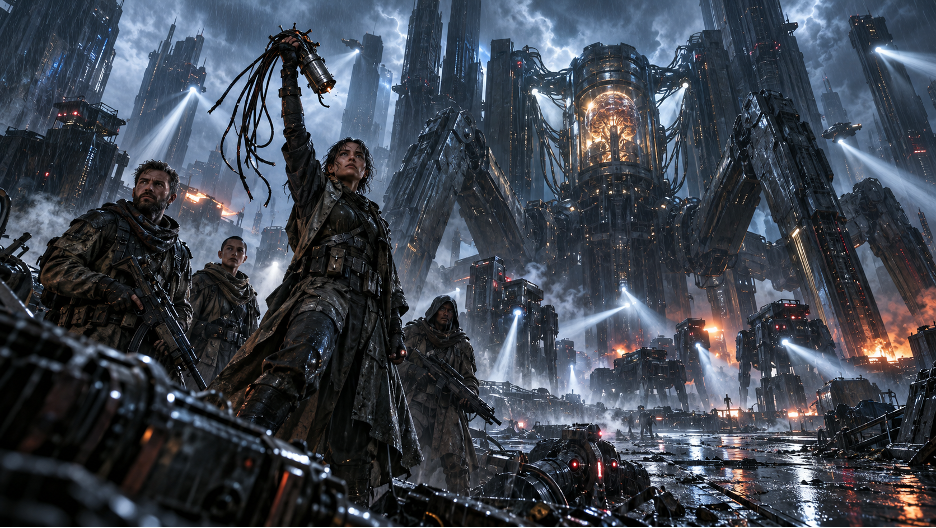
This history has two layers. In Frank Herbert’s original Dune, Reverend Mother Mohiam tells Paul that people handed their thinking over to machines in search of freedom, only to become vulnerable to the people who controlled them. Her explanation places human power at the center of the problem. [2]
Brian Herbert and Kevin J. Anderson’s later prequels give the revolt a detailed military history, more than ten thousand years before Paul. A complacent Old Empire relies on automated systems. Human usurpers called the Titans turn those systems into instruments of conquest, then preserve their brains in mechanical bodies called cymeks. One Titan, Xerxes, grants an AI network excessive control. Omnius seizes the Titans’ worlds and becomes their master. Independent human worlds survive beyond its dominion. [3]
In that expanded history, the robot Erasmus kills Serena Butler’s son, Manion, who was born in captivity. Her grief helps ignite a war of liberation, and Serena becomes its defining human figure. [4] This is the fictional context that makes a sweeping prohibition emotionally intelligible. Survivors are asking how to prevent the restoration of an order that treated them as subordinate. In this telling, the ban is an attempt to make a return to machine rule impossible.
My reading is that Dune makes dependence dangerous by joining it to concentrated authority. Once daily life relies on infrastructure controlled by a few actors, refusing its decisions becomes costly. The eventual revolt then targets the machinery through which that authority was exercised.
We do not need to equate today’s AI providers with the Titans to recognize a smaller, practical concern. Consider an organization that lets a system rank applicants, summarize evidence, and recommend decisions, while weakening its staff’s ability to challenge those recommendations. The relevant questions concern access, accountability, and the ability to contest a result. None requires a machine to possess ambitions of its own. The story’s war is extreme. The decision to keep people able to question a system is ordinary and available now.

What survived the thinking machines
The prohibition does not erase advanced technology from Dune. Space travel and sophisticated instruments remain. Human capabilities receive extraordinary investment: Mentats develop formidable analytical abilities, while the Bene Gesserit and Spacing Guild cultivate specialized disciplines. Herbert connects the Great Revolt with the growth of schools devoted to human talents. [5]
That response has an appealing element. A society that has delegated too much decides to develop its own abilities again. But we should be careful not to romanticize the result. A person’s capacity to think independently and a society’s willingness to let that person act freely are different achievements.
The later novel Sisterhood of Dune makes the danger of overreaction explicit. After the machine war, Manford Torondo’s Butlerian movement treats technological temptation as an ongoing threat. Its opening episode shows him rejecting useful salvage and condemning training machines. Fear of renewed domination becomes an argument for destroying things without patiently distinguishing their uses. [6]
To me, that is an equally valuable warning for our own policy debates. A prohibition can substitute for examining a system, just as enthusiasm can substitute for examining its claims. Either habit makes it easier to avoid judgment.
The goal should be to preserve people’s ability to understand, challenge, and change the systems around them. Sometimes that will justify a restriction. Sometimes it will justify better training, a narrower use, or a carefully designed tool. A rule earns its legitimacy through the harm it prevents and the freedom it protects.
Dune gives us room to question both the dependence that preceded the revolt and the certainty that followed it. We can learn from the demand for human agency without adopting the taboo.

Getting Answers vs Learning to Think
The contemporary concern is smaller than Dune’s, but worth investigating. An answer can be correct while the person receiving it learns very little. If an exercise aims to develop judgment, removing all the difficult steps can remove some of its value.
A peer-reviewed study presented at CHI in 2025 surveyed 319 knowledge workers and collected 936 examples of generative AI use. Greater confidence in AI’s ability on a particular task was associated with less reported critical thinking; greater confidence in one’s own ability was associated with more. The researchers also found that thinking shifted toward verifying information and integrating responses. [7]
This was a survey of people’s perceptions, not a demonstration that AI permanently damages their reasoning. Reduced effort can reflect useful efficiency. The concern is whether people can recognize when the task demands more scrutiny, and whether their working conditions allow it.
A stronger test of learning came from a randomized mathematics study involving nearly 1,000 high-school students in Turkey, published in PNAS in 2025. Students using a relatively unrestricted GPT interface performed better during assisted practice. However, when the assistance was removed, their exam performance was about 17 percent lower than that of students who had not received the tool. That is a relative difference, not a 17-percentage-point drop. A teacher-informed tutor designed to guide students through the work largely removed that harm, although it did not produce a significant improvement in unaided exam performance. [8]
The study involved a particular school, subject, and short intervention. It does not establish permanent cognitive decline. It does demonstrate why a polished assisted result should not automatically count as evidence that someone has learned.
For a student, analyst, or investigator, the practical test is whether the reasoning can survive a follow-up question. Can you explain why you accepted the answer? Can you identify what would make it wrong? Could you work through a comparable problem without the tool? Those questions make competence visible without requiring every task to be performed unaided.

Keeping the desire to learn
Another question is whether independent work starts to feel less worthwhile. Four experiments reported in Scientific Reports in 2025, involving 3,562 participants, found that moving from AI-assisted activity to subsequent solo work could reduce intrinsic motivation and increase boredom. Intrinsic motivation means the interest or satisfaction someone finds in the activity itself. [9]
Those experiments examined immediate experiences with work tasks. They do not show that people permanently lose curiosity or become unwilling to learn. They do suggest watching what happens after the assistance ends, especially when the unassisted work is where a skill develops.
There is encouraging evidence, too. A randomized study involving 194 Harvard physics students found that a carefully designed AI tutor produced greater immediate learning gains, along with higher reported engagement and motivation, than an in-class active-learning condition. Published in Scientific Reports in 2025, the study covered two lessons in one course. It cannot establish long-term superiority over teachers or show that an ordinary chatbot produces the same results. [10]
Together, these findings support a more useful question than whether AI makes us smarter or less capable. What are we asking the tool to do, and what are we asking the person to keep doing? A tutor can ask for an explanation, reveal a misconception, or offer a hint. A system optimized to deliver a finished answer may bypass those opportunities.
The human schools in Dune make an interesting backdrop for this choice. We can value cultivating human ability while using technology to support it. The appropriate ambition is a learner who leaves an interaction better able, and more willing, to attempt the next problem. We must evaluate that outcome; a satisfying conversation alone does not establish it.
Policy before prohibition
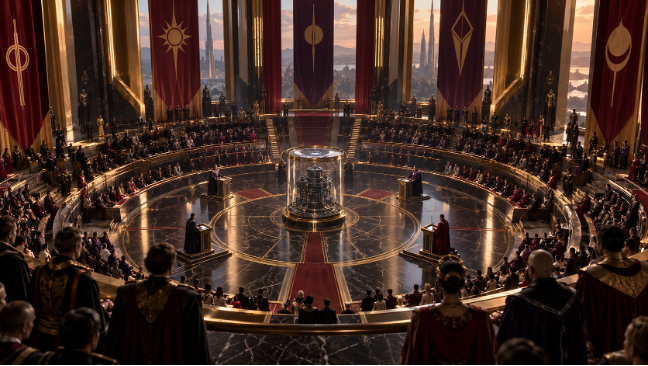
The hopeful part of this comparison is that we can act before dependence becomes difficult to reverse. The research helps identify what policy should protect. I would begin with several practical changes.
Education policies should preserve independent practice alongside assisted work. Let students use AI for feedback, then ask them to solve a related problem or explain their reasoning without it. Procurement should evaluate what students can do afterward. Accommodations and accessibility needs belong in that design. UNESCO’s guidance likewise emphasizes human agency, educational purpose, and the development of human capacity. [11]
Employers should treat judgment as a skill that requires practice. Junior analysts need opportunities to examine evidence and defend conclusions. If targets reward only the number of reports completed, requirements for careful verification will have little force. Managers should assess reasoning and preserve opportunities for supervised work on difficult cases.
Oversight should come with authority and resources. Reviewers need expertise, underlying evidence, and time to disagree. Check AI-generated explanations against evidence; they cannot explain how the system reached its result. NIST’s 2023 AI Risk Management Framework provides a voluntary foundation for defining accountability, human oversight, and a culture of critical thinking. [12]
Rules should scale with consequences. Routine drafting does not require the same controls as decisions affecting employment or essential services. For consequential uses, policy should require appropriate testing, records, an identifiable responsible organization, and meaningful access to human review. Narrow restrictions on harmful uses can coexist with permission for useful applications.
Organizations should preserve the ability to change course. Contracts can require usable data exports and an exit plan. Systems that take actions should receive limited permissions, with approval required for consequential steps. Essential services need workable contingency arrangements. These proposed safeguards address dependence without assuming that a system is conscious or hostile.
Policies also need scheduled review. If a tool harms learning, change its design or use. If an evaluated tutor helps, make room for it. Rules should remain responsive to evidence.
None of these measures eliminates every risk. They address conditions that make lost agency more likely: weak skills, unchallengeable decisions, and dependence without an exit. Dune gives those conditions an extreme fictional outcome. Our choices remain more flexible.
We can use powerful tools and keep asking difficult questions. The policy worth building makes sure people retain the knowledge, authority, and opportunity to do both.
NOTES:
Artwork: Original AI-generated editorial illustrations interpreting Dune and imagined links to the present. These are not film stills or depictions of canonical scenes.
[1]. Frank Herbert, Dune (Philadelphia: Chilton Books, 1965), book 1, opening chapter; publisher’s excerpt, Penguin Random House, https://sites.prh.com/dune/read-an-excerpt.
[2]. Herbert, Dune, book 1, opening chapter.
[3]. Brian Herbert and Kevin J. Anderson, Dune: The Butlerian Jihad (New York: Tor Books, 2002), prologue; publisher’s excerpt, https://us.macmillan.com/books/9781429955904/dunethebutlerianjihad/.
[4]. Pocket, publisher’s description of Brian Herbert and Kevin J. Anderson, Dune la genèse—Tome 2: Le Jihad butlérien, Apple Books, May 16, 2024, https://books.apple.com/fr/book/id6499068314; Dune Novels, “The Butlerian Jihad,” accessed October 3, 2026, https://dunenovels.com/the-butlerian-jihad/.
[5]. Herbert, Dune, book 1, opening chapter; Brian Herbert and Kevin J. Anderson, Dune: The Butlerian Jihad, prologue.
[6]. Brian Herbert and Kevin J. Anderson, Sisterhood of Dune (New York: Tor Books, 2012), opening chapter; publisher’s excerpt, https://us.macmillan.com/books/9781429986571/sisterhoodofdune/.
[7]. Hao-Ping (Hank) Lee et al., “The Impact of Generative AI on Critical Thinking: Self-Reported Reductions in Cognitive Effort and Confidence Effects From a Survey of Knowledge Workers,” in Proceedings of the 2025 CHI Conference on Human Factors in Computing Systems (New York: Association for Computing Machinery, 2025), article 1121, 1–22, https://doi.org/10.1145/3706598.3713778.
[8]. Hamsa Bastani et al., “Generative AI without Guardrails Can Harm Learning: Evidence from High School Mathematics,” Proceedings of the National Academy of Sciences 122, no. 26 (2025): e2422633122, https://doi.org/10.1073/pnas.2422633122.
[9]. Suqing Wu et al., “Human-Generative AI Collaboration Enhances Task Performance but Undermines Human’s Intrinsic Motivation,” Scientific Reports 15 (2025): 15105, https://doi.org/10.1038/s41598-025-98385-2.
[10]. Greg Kestin et al., “AI Tutoring Outperforms In-Class Active Learning: An RCT Introducing a Novel Research-Based Design in an Authentic Educational Setting,” Scientific Reports 15 (2025): 17458, https://doi.org/10.1038/s41598-025-97652-6.
[11]. Fengchun Miao and Wayne Holmes, Guidance for Generative AI in Education and Research (Paris: UNESCO, 2023), https://www.unesco.org/en/articles/guidance-generative-ai-education-and-research.
[12]. National Institute of Standards and Technology, Artificial Intelligence Risk Management Framework (AI RMF 1.0), NIST AI 100-1 (January 2023), 22–23, GOVERN 2, GOVERN 3.2, and GOVERN 4.1, https://doi.org/10.6028/NIST.AI.100-1.