

Biometrics, convenience, and consent
You glance at your phone, and it opens. A few hours later, an airport camera asks you to look up. At a gym, a screen offers to recognize your face instead of checking a membership card. The movement is almost the same each time. The decision you are making is not.
Biometrics can make security easier to use. They can also enable identification without deliberate interaction. I would judge a system by what it does, who controls it, where the information goes, and what happens if you decline. Those questions matter even more when traveling, because the rules governing access to your device may change even when its settings do not.
Unlocking a device you control
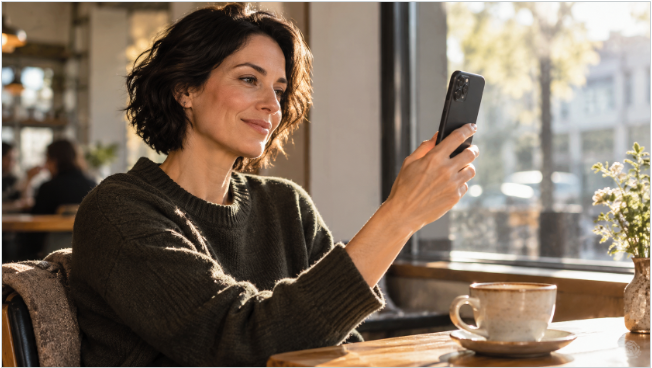
The first distinction is between verification and identification. Verification checks a claimed identity against its enrolled reference: does this person match the authorized user? Identification searches a collection of identities: who might this person be? Researchers often describe these as one-to-one and one-to-many comparisons. These are different tasks, but neither label tells you whether the information stays on a device or travels to a server. [1]
Apple’s Face ID illustrates a comparatively bounded design. Apple says the facial representation is encrypted, protected by the Secure Enclave, and kept on the device rather than sent to Apple or backed up to iCloud. Supported apps receive an authentication result, not the enrolled facial data. You can choose whether to enroll and can disable or reset it. Those claims describe this particular implementation; they should not be assumed to apply to every phone, app, or face-scanning service. [2]
A practical benefit is an unlock method people can use comfortably and consistently. For someone who struggles to enter a code, convenience can also mean accessibility. But the fallback matters: a weak device passcode remains a concern, and a biometric feature does not make the whole device or every account on it secure.
NIST’s current digital identity guidance treats biometrics as part of authentication with a physical authenticator, rather than as a standalone secret. Within that guidance, a non-biometric alternative must be available. This is a useful design principle, not a declaration that every commercial product worldwide follows the same rules. [3]
When the camera belongs to someone else
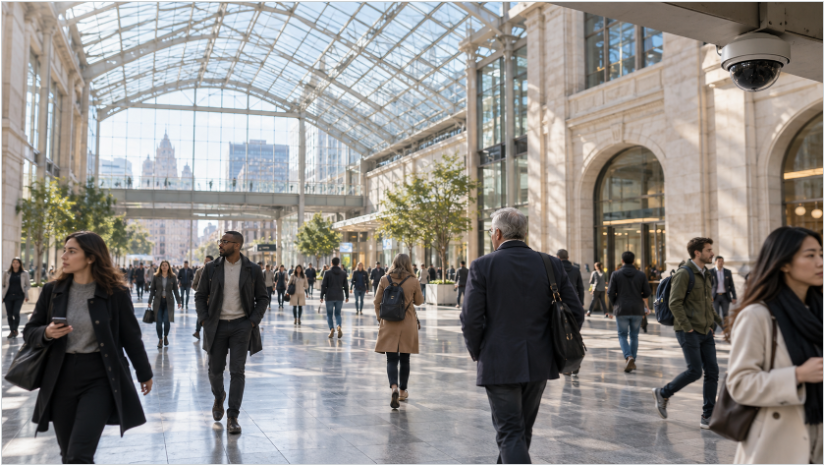
Now move the camera from your hand to a building entrance. You may have no account with the operator and no reason to know which database it uses. A system that compares passersby with a watchlist raises different questions from a phone checking its enrolled owner. Ordinary video recording and automated identity matching are also different activities; a visible camera alone does not tell you which is happening.
Helen Nissenbaum’s concept of contextual integrity offers a useful framework for thinking about this. Privacy depends partly on whether information flows appropriately within a particular setting. Applied here, agreeing to unlock your own phone does not settle whether a shopping center should identify you or connect your visits. Being visible to people nearby is different from having a persistent, searchable record assembled about you. That comparison is how I apply the framework. [4]
Accuracy matters, but it needs a more precise question than whether facial recognition “works.” A false rejection misses a real match; a false identification links different people. NIST’s evaluations show that performance and demographic differences vary with the algorithm, the task, and image conditions. Lighting and camera position matter too. A result from one test should not be treated as a universal score for every deployment. [5]
The consequences also differ. Having to enter a passcode after your phone fails to recognize you is inconvenient. Being incorrectly flagged at a checkpoint can be much more consequential. The operator should be able to explain how someone reviews a match, what other evidence is required, and how a person challenges an error.
Even perfect accuracy would leave a privacy question: should this identification happen at all? A system can identify the right person for a purpose that is excessive, unexpected, or difficult to contest. Better matching does not answer who should be watched.
Where the information goes and how long it stays
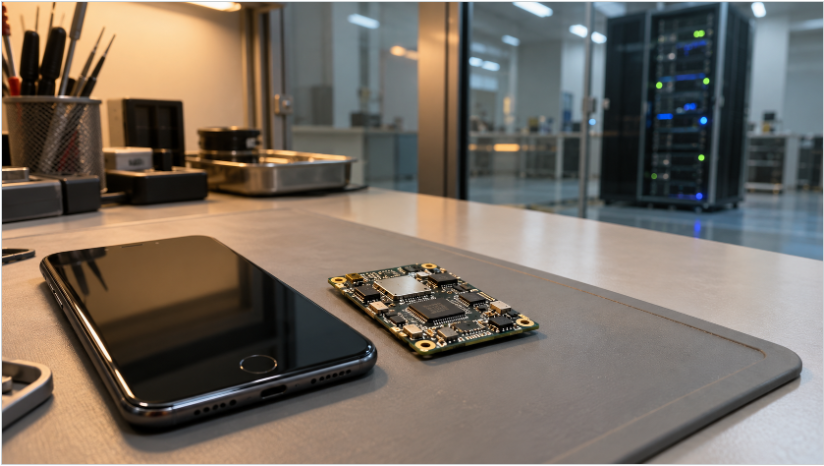
An operator may reassure you that it stores a template rather than a photograph. A template is a representation used for comparison, but it does not guarantee anonymity. Guangcan Mai and colleagues demonstrated reconstruction of recognizable faces from deep face templates in the systems they tested. Their study does not establish that every template is reversible or that Apple’s protected Face ID data can be extracted in this way. It does show why “we only store a template” is an incomplete security explanation. [6]
The familiar warning that you cannot change your fingerprint like a password also needs qualification. Your underlying physical traits are hard to replace, while some template-protection designs aim to let a compromised representation be revoked and reissued. The useful question is whether this system actually provides that protection, including resistance to matching your records across databases. [7]
Before enrolling, ask where the template and any original image are retained. Who can access them? Does a supplier operate the service? Are records linked to visits, purchases, or other identifiers? What triggers deletion, and does deletion cover backups and copies held by service providers? A statement about encryption answers only part of that inquiry.
The European Data Protection Board’s airport analysis illustrates the importance of control. In the passenger-flow arrangements it examined, storage with the individual, or central storage with encryption keys held solely by the individual, could satisfy the specific safeguards under review if minimum conditions were met. That was not blanket approval of airport facial recognition, and the opinion excluded border control. The architecture mattered alongside the purpose. [8]
Consent needs an alternative that works
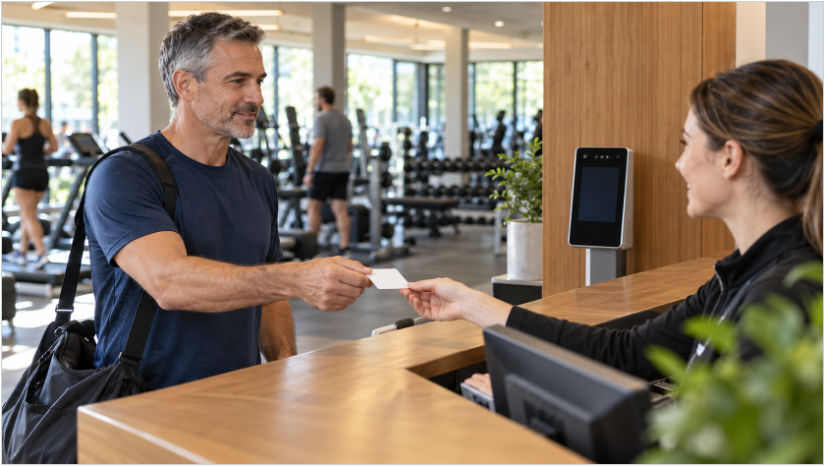
A genuine choice needs somewhere to go when the answer is no. If declining a facial scan means losing access to work, paying a substantial extra charge, or repeatedly explaining yourself in front of a queue, the alternative deserves scrutiny. A card, staffed check, or another authentication method can make the difference between an offer and a condition.
A study by Shikun Zhang, Yuanyuan Feng, and Norman Sadeh explored attitudes toward facial recognition through a ten-day study with 123 participants. Reactions to presented deployment scenarios reflected perceived benefits as well as concerns about transparency, data use, and control. It was not a nationally representative poll, but it helps explain why asking whether people “support biometrics” is too broad. The operator and purpose can change the answer. [9]
UK Information Commissioner guidance says that, where an organization relies on consent for biometric recognition, a suitable alternative and the ability to refuse or withdraw without detriment matter. Merely walking into a public recognition camera’s field of view is not consent. Other lawful grounds can exist, so this is not a claim that every legitimate biometric use requires individual agreement. [10]
Border enrollment is another category. For travelers covered by Europe’s Entry/Exit System, required biometric registration is not an optional airline boarding service: refusing required data can result in refusal of entry. The system also has defined retention rules; it generally retains each individual file for three years and one day after the last exit or refusal, with exceptions. Here, the relevant protections include lawful limits, oversight, and routes to correct data—not an assumption that consent can simply be withdrawn. [11]
The travel risks change by jurisdiction
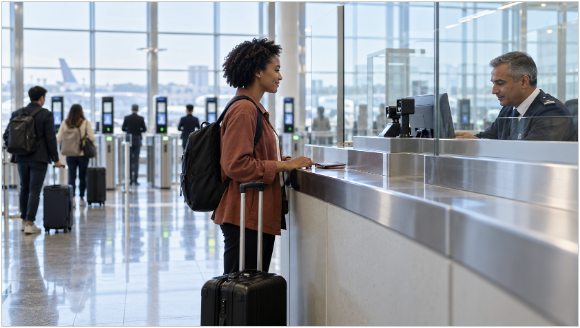
Would I ever turn off biometric unlocking before a trip? Yes, when someone could physically use my face or finger to unlock a device, the risk materially changes. I would treat that as a precaution within a broader travel plan. It does not establish a legal right to refuse access, and it does not stop a separate camera from recognizing me.
The following examples illustrate different reasons for caution, rather than a ranking of countries. Check the current rules for your destination, transit points, nationality, and immigration status before departure.
Mainland China. U.S. travel guidance warns of communications monitoring and searches of computers in hotel rooms without consent. For sensitive work or personal information, I would consider a minimal-data travel device, reconsider optional biometric enrollment, and assess whether passcode-only unlocking is appropriate. China also has facial-recognition rules requiring reasonable alternatives in covered situations where other methods meet the same need. Those privacy safeguards do not erase state powers or create a general border opt-out. Crossing the border does not itself upload a phone’s local biometric template. [12]
Hong Kong. Its legal framework must be considered separately from mainland China’s. March 2026 national-security rules provide for password or decryption-assistance demands during legally authorized device searches. Failure without reasonable excuse can carry criminal penalties. A passcode therefore does not solve the legal-access problem; the stronger preparation question is what information needs to travel at all. [13]
Russia. The U.S. State Department advises against travel and warns that devices and communications may be monitored, and devices searched or seized. It advises reconsidering bringing electronic devices. This is a broader risk than fingerprint versus passcode. Disabling biometric unlocking should not be presented as making such travel safe. [14]
United States. Avoid the familiar blanket claim that police can always compel a fingerprint but never a passcode. In United States v. Payne, an appeals court upheld an officer’s physical use of a parolee’s thumb. In United States v. Brown, another appeals court protected a compelled act of unlocking that communicated the person’s knowledge and control. Brown distinguished the circumstances rather than treating the cases as a simple contradiction. Neither was a border-search case, and neither supplies a universal rule for travelers. [15]
At the U.S. border, electronic-device inspections raise additional issues. Canada’s official advice for travel to the United States warns that officials may request passwords and that refusal can lead to delays or device seizure; noncitizens may also face admission consequences. Your immigration status matters. A temporary switch to passcode-only access is a technical choice, not a promise that the device cannot be examined. [16]
United Kingdom. Under the specific Schedule 7 counterterrorism examination powers at ports, the current code explicitly covers access using fingerprints, face or voice recognition, as well as PINs and passcodes. These are particular statutory powers, not a description of every routine immigration interaction. Disabling biometrics does not remove an applicable duty to provide access. [17]
New Zealand. Customs says device searches require reasonable suspicion of relevant offending. Where access is legally required, failing to provide it can lead to prosecution and a court-imposed fine of up to NZ$5,000. The legal threshold matters, but so does the obligation that follows once it is met. A password is not a general exemption.
Make the decision before you travel
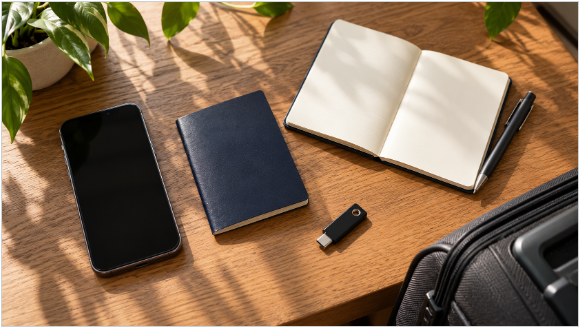
My practical approach would begin with the information, then the device settings. Review what is stored locally and what signed-in accounts make accessible. A spare phone carrying the same synchronized messages, documents, and account access may offer less separation than its clean appearance suggests. Keep only what the trip requires, maintain a secure backup, and coordinate work-related decisions with the organization responsible for that information.
If you choose passcode-only unlocking for a sensitive trip, use a strong passcode you can reliably remember and test the configuration before leaving. Learn the manufacturer’s temporary-disable procedure and when biometrics resume. On an iPhone, Apple documents holding the side button and either volume button for two seconds, then pressing the side button after the sliders appear; the next passcode unlock enables Face ID again. A temporary interruption is different from leaving biometric unlocking disabled throughout a trip. [19]
For optional enrollment, ask for the alternative before standing in front of the scanner. Read the retention and sharing terms, and distinguish the airline’s convenience program from a government entry requirement. For a consequential trip, obtain jurisdiction-specific advice in advance. These examples explain the issues; they are not instructions to refuse a lawful demand.
For organizations, the same questions belong in procurement. Require a defined purpose, a documented data flow, a retention limit, an effective alternative where appropriate, and a way to correct errors. A vendor’s demonstration can show speed. It cannot, by itself, establish that the proposed use is necessary or that people have a meaningful choice.
I can see a sound reason to use biometrics on a well-designed personal device and a sound reason to decline an optional enrollment elsewhere. Those positions are compatible. The decision should follow the purpose, the people who control the system, and the choices available to the person being recognized. Convenience is valuable. Understanding what we have agreed to is valuable too.
NOTES:
AI-generated editorial illustrations. People and locations shown are illustrative, not evidence of a particular deployment.
We checked sources and legal guidance on October 10, 2026.
[1] Anil K. Jain, Karthik Nandakumar, and Arun Ross, “50 Years of Biometric Research: Accomplishments, Challenges, and Opportunities,” Pattern Recognition Letters 79 (2016): 81–84, https://doi.org/10.1016/j.patrec.2015.12.013.
[2] Apple, “Face ID & Privacy,” December 12, 2025, https://www.apple.com/legal/privacy/data/en/face-id/.
[3] National Institute of Standards and Technology, Digital Identity Guidelines: Authentication and Authenticator Management, NIST SP 800-63B-4 (2025), sec. 3.2.3, https://pages.nist.gov/800-63-4/sp800-63b.html.
[4] Helen Nissenbaum, “Privacy as Contextual Integrity,” Washington Law Review 79, no. 1 (2004): 138–43, https://digitalcommons.law.uw.edu/wlr/vol79/iss1/10/.
[5] National Institute of Standards and Technology, “Face Recognition Technology Evaluation: Demographic Effects in Face Recognition,” accessed October 10, 2026, https://pages.nist.gov/frvt/html/frvt_demographics.html.
[6] Guangcan Mai et al., “On the Reconstruction of Face Images from Deep Face Templates,” IEEE Transactions on Pattern Analysis and Machine Intelligence 41, no. 5 (2019): 1188–1202, https://doi.org/10.1109/TPAMI.2018.2827389.
[7] Anil K. Jain, Karthik Nandakumar, and Abhishek Nagar, “Biometric Template Security,” EURASIP Journal on Advances in Signal Processing 2008 (2008), article 579416, https://doi.org/10.1155/2008/579416.
[8] European Data Protection Board, Opinion 11/2024 on the Use of Facial Recognition to Streamline Airport Passengers’ Flow (Compatibility with Articles 5(1)(e) and (f), 25 and 32 GDPR), adopted May 23, 2024, 2–4, 6, https://www.edpb.europa.eu/system/files/2024-05/edpb_opinion_202411_facialrecognitionairports_en.pdf.
[9] Shikun Zhang, Yuanyuan Feng, and Norman Sadeh, “Facial Recognition: Understanding Privacy Concerns and Attitudes Across Increasingly Diverse Deployment Scenarios,” in Seventeenth Symposium on Usable Privacy and Security (SOUPS 2021) (USENIX Association, 2021), 248–54, https://www.usenix.org/conference/soups2021/presentation/zhang-shikun.
[10] Information Commissioner’s Office, “How Do We Process Biometric Data Lawfully?,” accessed October 10, 2026, https://ico.org.uk/for-organisations/uk-gdpr-guidance-and-resources/lawful-basis/biometric-data-guidance-biometric-recognition/how-do-we-process-biometric-data-lawfully/.
[11] French Ministry of the Interior, Directorate-General for Foreign Nationals in France, “Informations about the Processing of Personal Data in the Entry/Exit System (EES),” accessed October 10, 2026, https://www.immigration.interieur.gouv.fr/en/limmigration-en-france/circulation-aux-frontieres/informations-about-the-processing-of-personal-data-in-the-entryexit-system-ees.
[12] U.S. Department of State, “China Travel Advisory,” accessed October 10, 2026, https://travel.state.gov/en/international-travel/travel-advisories/china.html; Cyberspace Administration of China and Ministry of Public Security, “Measures for the Security Management of Facial Recognition Technology Applications” (title translated from Chinese), March 21, 2025, art. 10, https://www.cac.gov.cn/2025-03/21/c_1744174262156096.htm.
[13] Hong Kong Special Administrative Region Government, “2026 Implementation Rules for Amending the Implementation Rules for Article 43 of the Law of the People’s Republic of China on Safeguarding National Security in the Hong Kong Special Administrative Region,” LC Paper No. CB(3)224/2026(01), March 23, 2026, 4–7, https://www.doj.gov.hk/en/legco/pdf/ajls20260324e1.pdf.
[14] U.S. Department of State, “Russia Travel Advisory,” December 29, 2025, accessed October 10, 2026, https://travel.state.gov/en/international-travel/travel-advisories/russia.html.
[15] United States v. Payne, 99 F.4th 495 (9th Cir. 2024), slip op. at 22–33, https://cdn.ca9.uscourts.gov/datastore/opinions/2024/04/17/22-50262.pdf; United States v. Brown, 125 F.4th 1186 (D.C. Cir. 2025), slip op. at 21–29, https://media.cadc.uscourts.gov/opinions/docs/2025/01/23-3074-2094718.pdf.
[16] Government of Canada, “United States Travel Advice,” under “Electronic Devices,” accessed October 10, 2026, https://travel.gc.ca/destinations/united-states.
[17] Home Office, Examining Officers and Review Officers under Schedule 7 to the Terrorism Act 2000: Code of Practice (October 2025), paras. 44, 60–63 and annex A, https://www.gov.uk/government/publications/codes-of-practice-for-officers-using-examination-powers-at-ports/examining-officers-and-review-officers-under-schedule-7-to-the-terrorism-act-2000-accessible-version.
[18] New Zealand Customs Service, “Electronic Device Examinations,” updated July 9, 2025, https://www.customs.govt.nz/travel-to-and-from-new-zealand/electronic-device-examinations.
[19] Apple, “Set Up Face ID on iPhone,” under “Temporarily Disable Face ID,” accessed October 10, 2026, https://support.apple.com/guide/iphone/set-up-face-id-iph6d162927a/ios.